
Diplomacy in international relations is not merely a political necessity but the foundation of trust and dialogue between nations. No country can achieve progress unless it steps beyond its borders and builds relationships of peace, cooperation, and goodwill with others. In this context, the recent visit of Afghanistan’s Foreign Minister, Maulvi Amir Khan Muttaqi, to India is being seen as a positive and encouraging development, not only in South Asian politics but on the global stage. This visit clearly indicates that both India and Afghanistan are entering a new era of relations one focused on future possibilities rather than past obstacles. The ties between India and Afghanistan are deeply rooted in history. From Buddhist movements to the Mughal Empire, both regions have always been connected at cultural, scholarly, and commercial levels. After independence, India consistently followed a policy of goodwill, cooperation, and equality toward Afghanistan. Whether during the Cold War or various Taliban regimes, India never adopted hostility or interference. Instead, it supported Afghanistan in fields such as education, health, and infrastructure. This is why Afghan citizens continue to hold deep respect for India even today. This historical background gives deeper meaning to the Taliban foreign minister’s recent visit a revival of the spirit of mutual respect and cooperation.
A New Diplomatic Chapter
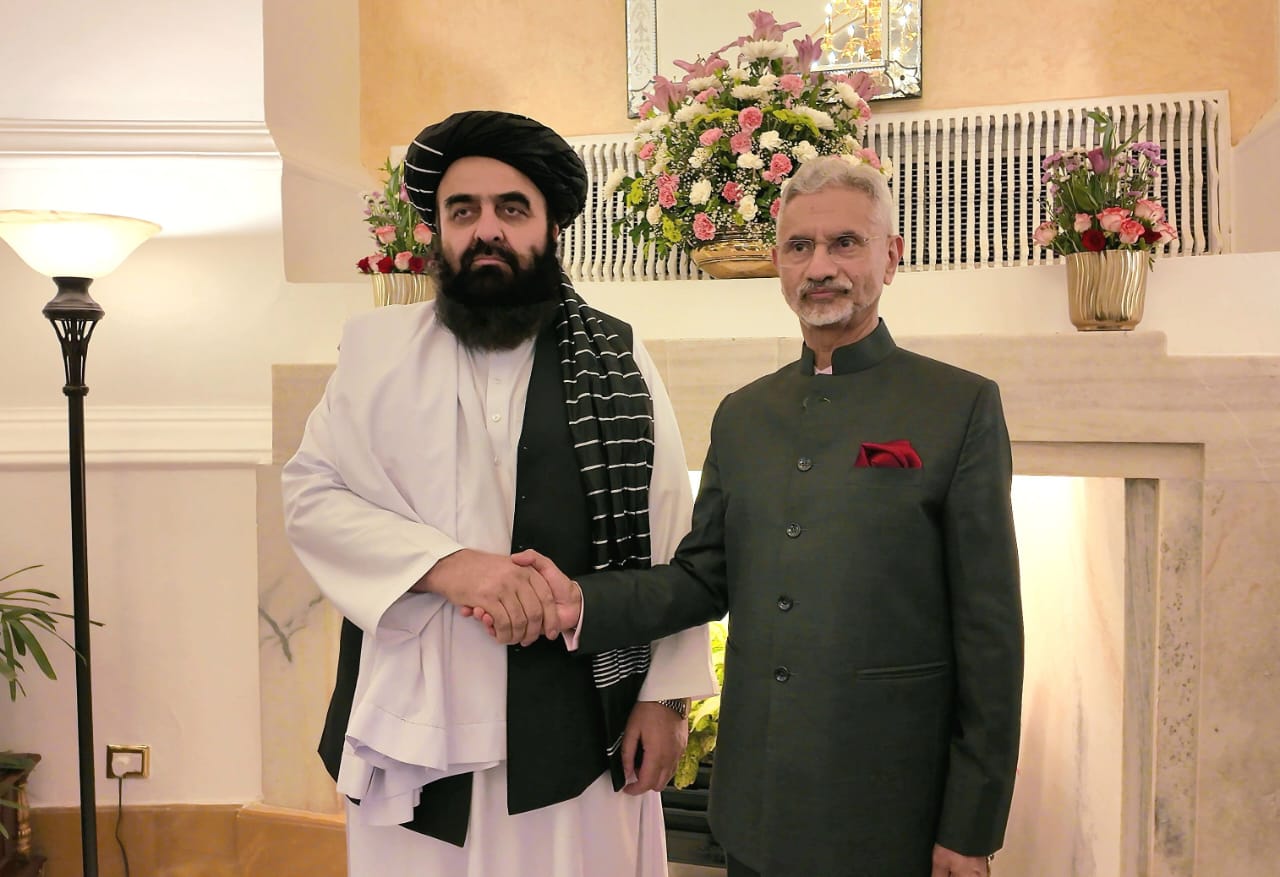
On October 10, 2025, Taliban Foreign Minister Maulvi Amir Khan Muttaqi met with India’s External Affairs Minister Dr. S. Jaishankar in New Delhi a moment considered a diplomatic milestone in South Asia. This meeting proved that India makes decisions not on mere ideological differences but on practical realities and the broader interests of the region. When the Taliban regained power in 2021, many countries distanced themselves from them. However, India, with strategic foresight, adopted a balanced approach. The establishment of an Afghan Technical Mission in Delhi, which is now transitioning into a formal embassy, symbolizes this prudence.During the meeting, India demonstrated genuine humanitarian concern by handing over five ambulances to the Afghan Foreign Minister part of a total donation of twenty ambulances with modern medical equipment. India also announced the supply of MRI and CT scan machines, vaccines, and cancer medicines to Afghan hospitals. This action showed that India’s goal is not political dominance but service to humanity. This diplomatic gesture will lay a new foundation of trust between the two nations. The Indian government’s balanced and insightful conduct on this occasion deserves commendation, highlighting India’s commitment to global peace and development rather than confrontation.Direct dialogue with the Taliban is an acknowledgment that peace in Afghanistan is integral to peace in the whole region. If both countries move forward together, a new dawn of peace could rise in South Asia.
Regional Stability and Cooperation
The Taliban Foreign Minister’s visit has raised significant hopes for regional peace and economic collaboration. Afghanistan, positioned as a geographical bridge linking South Asia with Central Asia, can play a vital role. If this bridge is strengthened, India can expand its trade access to Central Asian nations. For India’s market, this presents an opportunity to reach vast natural and energy resources. Should the Taliban government cooperate, both economies could be revitalized.Afghanistan is rich in natural resources iron, copper, gold, lithium, and other minerals. Access for Indian industries to these could contribute to India’s industrial growth and help stabilize Afghanistan’s economy. Moreover, India can offer its expertise in construction, education, medicine, agriculture, and infrastructure. Together, both nations can become partners in mutual progress.Additionally, if the Turkmenistan-Afghanistan-Pakistan-India (TAPI) gas pipeline project is reactivated with Taliban cooperation, it could serve as a new energy corridor for the entire region. Given India’s growing energy needs, this project holds strategic value, ensuring energy supply for India and transit revenue for Afghanistan.
Cooperation on Security and Counterterrorism
India has consistently stressed that Afghan soil should never be used for terrorist activities. If the Taliban government offers practical cooperation and joint security measures are implemented, it would mark a major success for New Delhi. Such initiatives would strengthen India’s internal security and help enhance the Taliban’s international credibility.
India’s Positive Role in Global Peace
This visit reaffirmed a vital truth India’s foreign policy is rooted in peace, dialogue, and cooperation. In today’s world, where many nations act out of selfish interests, India continues to prioritize humanity, balance, and harmony. Hence, this visit symbolizes hope not only for both nations but for the entire region.The Indian government deserves praise for this visionary step. By choosing dialogue and cooperation over isolation and hostility, India has proved its commitment to peace and morality on a global scale. The engagement with the Taliban reflects diplomatic maturity and highlights India’s ethical and humanitarian character in international relations.
Visit to Darul Uloom Deoband: A Cultural Connection
The most spiritual and cultural aspect of this visit was the Taliban Foreign Minister’s scheduled visit to Darul Uloom Deoband on October 11, 2025. His statement recognizing Deoband as an ancient center of religious and scholarly excellence where Afghan students have come for centuries signifies both respect and renewal of a long-standing historical bond. Relations between Afghanistan and Deoband date back to the 19th century. Thousands of Afghan scholars have studied there and contributed to religious and intellectual activities on their return home. This visit lays the groundwork for a new academic chapter. If the Taliban government enhances cooperation in education, Afghan students could once again benefit from India’s educational institutions. Indian universities, particularly Islamic ones, are centers that combine traditional and modern knowledge. Such academic exchange could strengthen intellectual ties and mutual understanding between both nations. For Afghanistan, Deoband is not only a religious institution but also a cultural symbol. Afghans regard it as a fortress of learning. Maulvi Amir Khan Muttaqi’s visit there symbolizes spiritual brotherhood between the two countries, further fostering trust, respect, and goodwill.The Taliban Foreign Minister’s visit to India was not merely a formal meeting but the beginning of a new chapter in history. It proves that when intentions are sincere, new foundations for relationships can be built. For both Afghanistan and India, this moment offers an opportunity to become genuine partners in development, peace, and prosperity. The visit revitalizes not just diplomatic ties but also human, educational, commercial, and spiritual relations. If nurtured on the principles of trust, dialogue, and cooperation, this relationship can illuminate South Asia’s future a future where India continues to uphold the banner of peace, friendship, and humanity.
Assistant Professor, Faculty of Theology, Aligrah Muslim University, Aligarh.