
Eight Days of Hunger Strike at Jamia Millia Islamia: Students Demand Their Democratic Rights
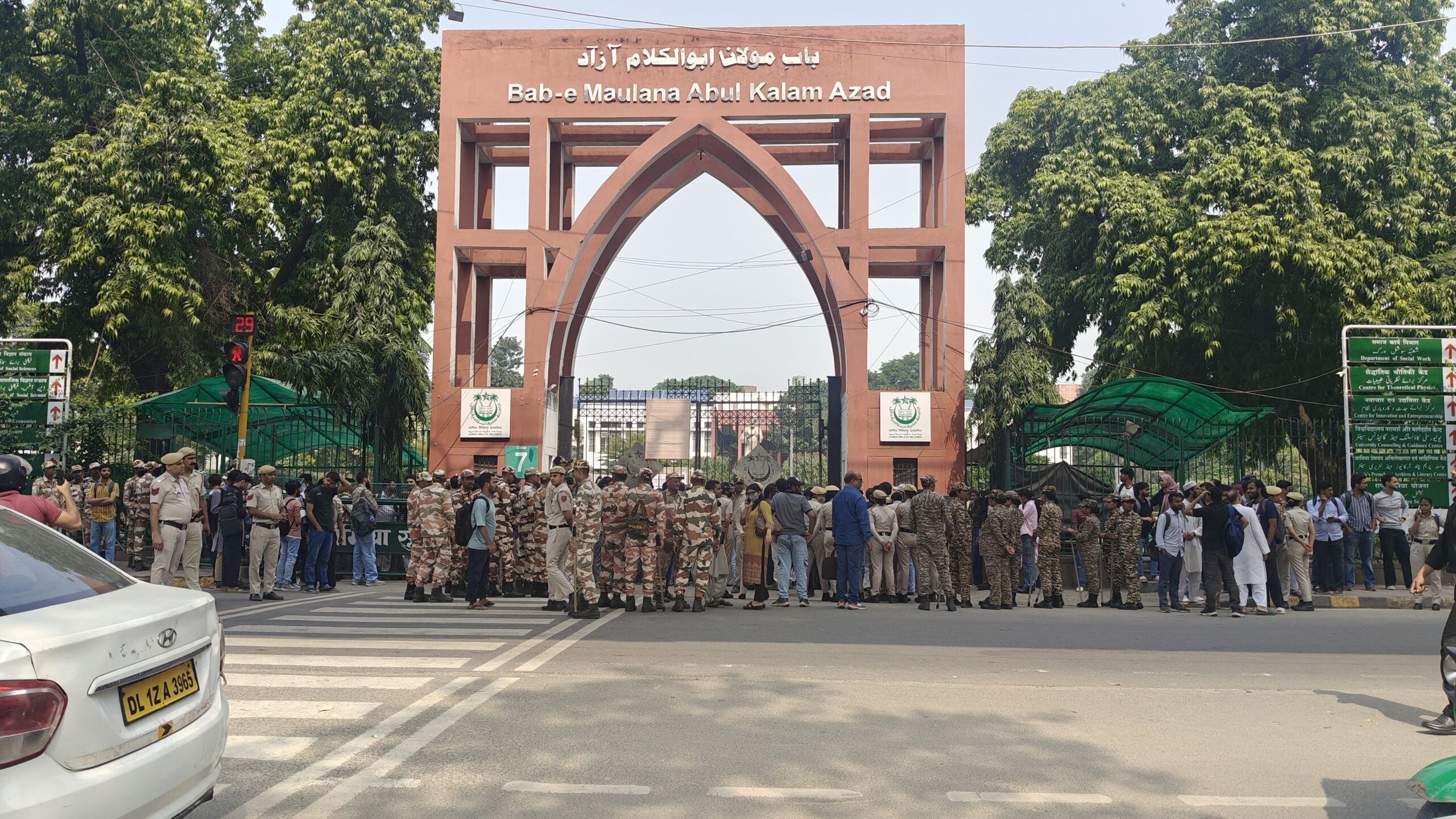
The protest demanding the restoration of the Jamia Millia Islamia Students’ Union has entered its eighth day, raising fundamental questions about democratic representation, student rights, and the university administration’s response to dissent.The movement began on October 12, when a student, Mohammad Jasim Khan, announced that he would sit on a hunger strike at the designated protest site. Within hours, he was removed from the site by the university’s proctorial team and security guards. He subsequently returned to the main campus and resumed his hunger strike at Gulistan-e-Ghalib, in front of the Ghalib statue near Gate No. 7.
Five students began an indefinite hunger strike demanding the restoration of the Students’ Union elections, which were discontinued in March 2006. What began as a protest led by a handful of students gradually developed into a wider movement, attracting students from various departments and drawing attention beyond the campus.
The Early-Morning Removal and Escalation of the Protest
On Saturday morning, at around 5:30 a.m., the university’s proctorial team and security personnel entered the campus and removed the protesting students. According to the protesters, the security personnel switched off the lights, manhandled students, dragged them out of the campus, and assaulted them. The students were subsequently detained.
The university, however, offered a different account, claiming that its security personnel had acted in self-defence and alleging that guards had been abused and their clothes torn. These competing accounts make an impartial inquiry into the incident essential.
Later that morning, the students returned to Gate No. 7 and resumed their protest. Delhi Police and paramilitary personnel were deployed in large numbers as tensions escalated.
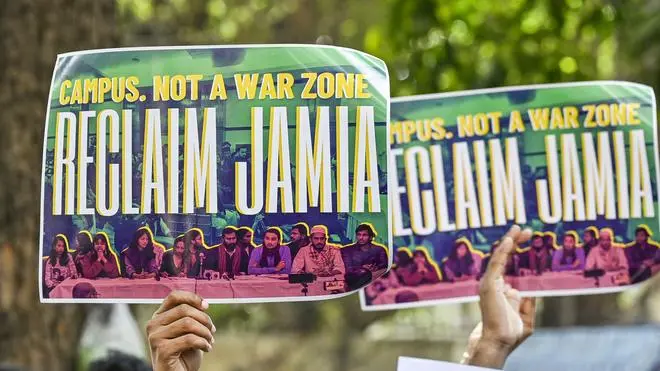
The movement continued to gather momentum throughout the day. Students from different departments joined the demonstration, and the growing crowd eventually re-entered the campus and reclaimed the protest site despite resistance from the police and security personnel.
The incident transformed the protest into a larger confrontation over student representation, the administration’s handling of dissent, and the disciplinary measures imposed on those involved.
Suspensions and Rustication: The Cost of Demanding Representation
The administration’s disciplinary action against protesting students has further intensified the controversy.
According to the protesters, Ebin Basil was rusticated for an academic year, while Mohammad Jasim Khan was suspended for six months. Students have demanded the withdrawal of these disciplinary orders, the resignation of the Chief Proctor, and an independent inquiry into the alleged use of force against protesters.
The severity of these measures raises serious questions about proportionality, procedural fairness, and the university’s approach to student dissent.
When students demand an elected representative body, should the administration respond primarily through disciplinary action, or should it address the underlying demand through meaningful dialogue?
This is the central question confronting Jamia Millia Islamia.
The Seven-Member Committee: A Step Towards Resolution or a Response to Escalation?
Following the escalation, the university administration constituted a seven-member high-level committee to engage with the protesting students, examine their demands, and take steps towards restoring peace and normalcy on campus.
In its press release dated October 19, 2026, the university stated that the committee had been formed following discussions among senior university officials, including the Vice-Chancellor, Registrar, Controller of Examinations, deans, Chief Proctor, and other functionaries.
The administration described constructive dialogue, mutual trust, and cooperation as essential to resolving the impasse.
Dialogue is undoubtedly necessary. However, the formation of a committee does not, by itself, resolve the dispute.
The students are not merely protesting over a temporary administrative grievance. Their principal demand is the restoration of the Students’ Union, whose elections have remained suspended since 2006.
The question, therefore, is whether the committee will meaningfully address this demand or focus primarily on restoring normalcy without resolving the underlying issue.
Normalcy cannot be treated as an end in itself while the central grievance remains unaddressed. The administration must clarify whether the committee is prepared to examine the restoration of union elections or whether its mandate is limited to managing the current protest.
What Does the Administration Say About the Students’ Union?
In its October 19 press release, Jamia Millia Islamia presented three principal arguments to explain its position.
First, the administration stated that the Students’ Union elections were discontinued in March 2006 following recurrent incidents of violent clashes, attacks on teachers, and disruptions of classes.
Second, it argued that the Delhi High Court’s 2022 judgment did not direct the university to conduct Students’ Union elections. According to the administration, the court accepted the submissions made by the university’s standing counsel and disposed of the matter without directing JMI to hold elections.
Third, the administration maintained that students already have an alternative system of democratic representation through elected departmental subject associations.
According to the press release, students vote by secret ballot to elect three office-bearers in their respective departments and centres: a Vice-President, General Secretary, and Joint Secretary. The university described this arrangement as a system that has served students well over the years.
However, these arguments do not adequately address the fundamental question raised by the protesters: Why should departmental representation be considered sufficient when students are demanding a university-wide, democratically elected Students’ Union?
Departmental Associations Are Not a Substitute for a Students’ Union
The administration’s reliance on departmental subject associations overlooks an important distinction between departmental representation and university-wide student representation.
Subject associations operate within individual departments and centres. Their elected representatives primarily address issues concerning students within those academic units.
A Students’ Union, by contrast, can provide a collective platform for students across the university to raise common concerns, engage with the administration, and advocate for their academic, social, and institutional interests.
The two structures may complement each other, but they are not interchangeable.
Similarly, Class Representatives (CRs) cannot be treated as equivalent to an elected Students’ Union. CRs generally represent individual classes, while departmental associations represent students within particular academic units. Neither arrangement necessarily provides a university-wide representative body with a mandate to speak on behalf of the entire student community.
The administration’s argument, therefore, raises a larger question about the nature of student democracy at Jamia.
Representation is not merely about having elected office-bearers. It is also about the scope of their mandate, their independence, and their ability to hold the administration accountable.
Departmental representatives operate within institutional structures in which the influence of department heads and university officials may constrain their independence. This does not mean that every departmental association lacks autonomy, but it does highlight why departmental representation cannot automatically be considered an adequate replacement for a university-wide Students’ Union.
Students are demanding an institution-wide platform through which they can collectively articulate their concerns. Pointing to existing departmental associations does not resolve that demand.
The 2006 Suspension: Can a Two-Decade-Old Decision Remain the Answer?
The university has cited the history of violence in 2006 to explain why Students’ Union elections were discontinued.
The administration’s concerns about campus violence, disruptions to classes, and the safety of teachers and students deserve serious consideration. A democratic institution must ensure that elections are conducted peacefully and that elected representatives remain accountable for their conduct.
However, the existence of past violence does not, by itself, establish that the indefinite suspension of university-wide student elections is the only possible solution.
Nearly two decades have passed since 2006. The administration must explain why the problems associated with the earlier Students’ Union cannot be addressed through transparent electoral procedures, enforceable codes of conduct, fair disciplinary mechanisms, and safeguards against violence.
If the earlier system experienced serious problems, the appropriate question is how to reform it rather than whether student representation should remain permanently restricted.
Past violence may explain the original decision, but it cannot replace a fresh examination of whether that decision remains justified today.
The university’s own press release acknowledges that the present administration, which assumed office in October 2024, is committed to finding an amicable resolution to the long-standing impasse.
That commitment must now translate into meaningful engagement with the students’ principal demand.
What Did the Delhi High Court Decide in 2022?
The administration has emphasised that the Delhi High Court’s 2022 judgment did not direct JMI to conduct Students’ Union elections.
This distinction is important, but it must be interpreted carefully.
The absence of a judicial direction requiring the university to conduct elections is not, by itself, equivalent to a judicial prohibition on holding elections. Nor does it necessarily settle the broader question of what form of student representation the university should provide.
The precise legal implications depend on the judgment’s actual reasoning, the relief sought by the petitioners, and the court’s operative directions.
Therefore, the 2022 judgment should be examined in its entirety before drawing conclusions about the university’s legal obligations or the students’ rights.
Nevertheless, the administration’s reliance on the judgment does not answer the broader institutional question: should Jamia reconsider the suspension of university-wide student elections after nearly twenty years?
A legal argument about what the court did or did not direct cannot, on its own, substitute for a substantive discussion about democratic representation.
Normalcy Without Democracy?
The university’s press release repeatedly emphasises peace, harmony, cooperation, academic continuity, and the protection of Jamia’s reputation and national and international rankings.
These are legitimate institutional concerns. Students, faculty members, and university staff all have an interest in a peaceful campus and an environment conducive to learning.
However, institutional reputation and student representation should not be presented as competing objectives.
A university’s standing depends not only on academic performance and rankings but also on its ability to address grievances fairly, uphold principles of accountability, and provide meaningful avenues for participation in institutional life.
Calling for normalcy does not resolve the underlying dispute if the students’ principal demand remains unanswered.
Nor should a demand for democratic representation be reduced to a law-and-order problem simply because the protest has escalated.
The administration must distinguish between addressing the immediate disruption and resolving the institutional grievance that gave rise to it.
Normalcy is not simply the absence of protest. It also requires addressing the reasons students believe they must protest in the first place.
A committee can facilitate dialogue, but dialogue must involve a serious examination of the students’ demands. Otherwise, the process risks becoming a mechanism for managing dissent rather than resolving the dispute.
What Should Happen Next?
The current impasse requires concrete steps from both the administration and the university community.
First, the seven-member committee should engage directly with the protesting students and clarify whether its mandate includes examining the restoration of the Students’ Union.
Second, the administration should provide a transparent explanation of the legal and institutional considerations governing the suspension of elections and the available options for restoring university-wide student representation.
Third, the disciplinary orders imposed on the protesting students should be examined through fair procedures, with due consideration given to the circumstances and proportionality of the penalties.
Fourth, the allegations concerning the early-morning removal of protesters and the use of force should be investigated impartially. The accounts of both students and security personnel should be examined before conclusions are reached.
Finally, the administration should establish a clear process for dialogue, including a timeline for responding to the students’ demands.
These steps would help move the dispute beyond competing statements and towards a substantive resolution.
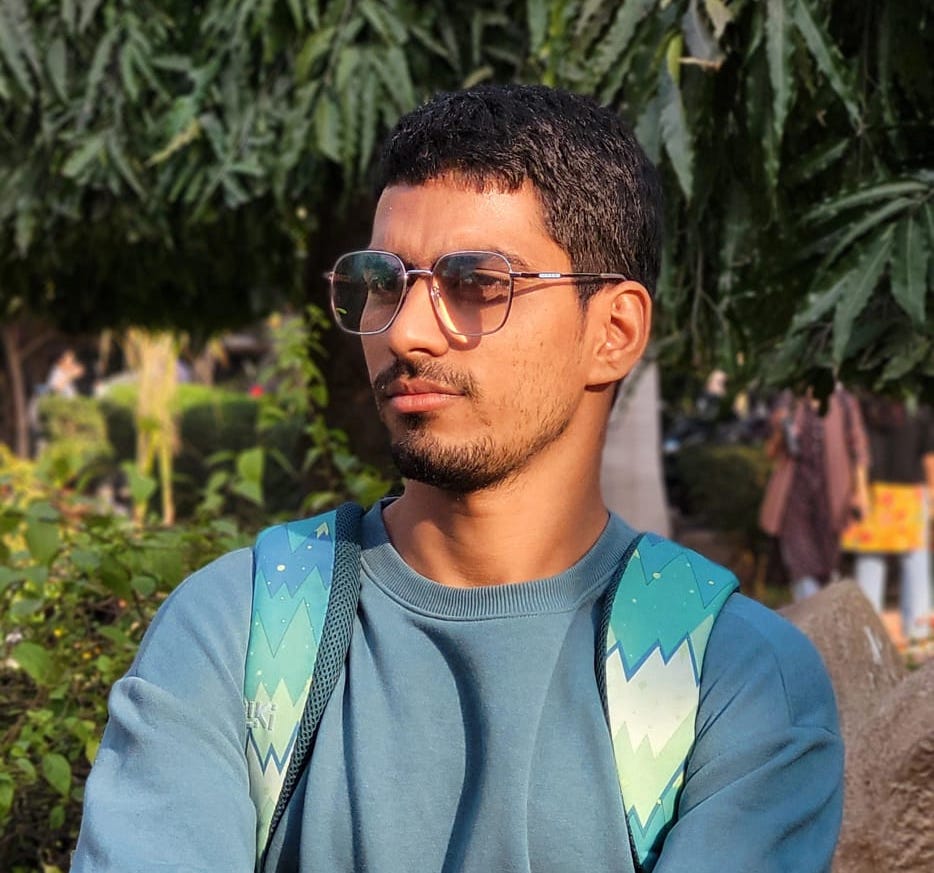
Mohammad Hesham Atik is an undergraduate student of Psychology at Jamia Millia Islamia, with a minor in Economics. He has also pursued certified courses in Urdu from Jawaharlal Nehru University. His interests include psychology, social issues, and cultural studies.