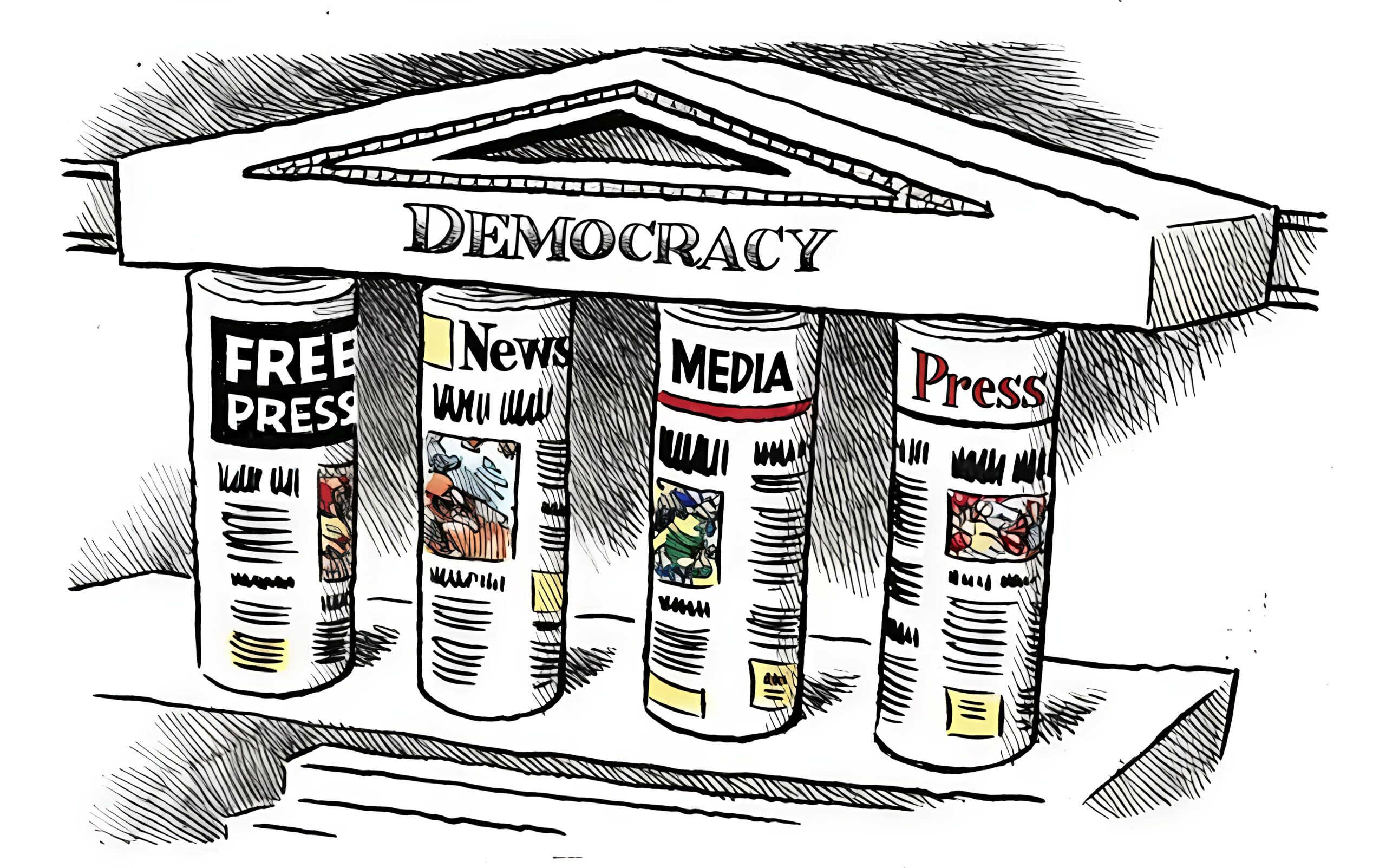
The media is often described as the fourth pillar of democracy, a role that is not symbolic but functional. Its core responsibility is to hold power accountable through investigation, questioning, and public scrutiny. In a democratic system, the media acts as a crucial link between the state and citizens, ensuring transparency in governance and enabling informed public debate.
While the Constitution of India does not explicitly mention the media, its freedom is derived from Article 19(1)(a), which guarantees freedom of speech and expression. The Supreme Court clarified this position early on in Romesh Thapar vs Union of India in 1950, when it ruled that freedom of the press is an essential part of this constitutional right. This judgment laid the foundation for press independence in India, which was later reinforced through subsequent rulings.
In theory, the media functions as a watchdog, constantly monitoring those who wield power. This role is vital because democracy depends on the ability to question authority. At the same time, this freedom is not absolute. Article 19(2) allows reasonable restrictions in the interests of sovereignty, security, public order, and morality. Article 361A further protects the media by allowing the publication of true and fair reports of legislative proceedings, strengthening transparency within democratic institutions.
In the years following Independence, Indian media largely avoided confrontation with political authority. Until around 1967, the press functioned more as a compliant observer than a critical examiner. This began to change between 1967 and 1974, when journalism took on a more assertive role. Investigative reporting during this period exposed corruption, administrative failures, and misuse of power. The press also played a significant role in shaping democratic consciousness during and after the Emergency, particularly once censorship was lifted.
Over time, however, the watchdog role began to distort. What emerged was a more aggressive but selective form of scrutiny. Media attention increasingly shifted from governance and policy to the personal lives of political figures. Sensationalism and competition for viewership began to dominate news coverage. Journalism moved away from reporting facts towards shaping narratives, often blurring the line between information and opinion.
This trend continues today. Many news platforms prioritise debates, personal controversies, and polarising narratives over sustained discussion on unemployment, healthcare, education, or economic policy. Headlines often emphasise spectacle rather than verification, raising serious ethical concerns. As Jawaharlal Nehru once said, “There is no such thing as absolute freedom, freedom is always accompanied by responsibility.” a principle that applies directly to the media.
Recent years have also seen the return of lapdog tendencies, with sections of the media appearing closely aligned with political power. At the same time, politics itself has become increasingly mediated. Political actions are now designed to attract coverage rather than to achieve substantive policy outcomes. Governance risks becoming performance driven, with perception taking precedence over reform.
Despite these challenges, the role of the media in a democracy remains indispensable. History shows that when journalism has acted with courage and integrity, it has exposed corruption, enforced accountability, and strengthened democratic institutions. The future of Indian democracy therefore depends not only on a free press, but on a responsible one.
For the fourth pillar to remain strong, it must reject both submission and sensationalism. It must reclaim its role as a true watchdog, committed to truth, public welfare, and constitutional values.
Sayed Mobashar Ali is a B.A. Honours Psychology student at Jamia Millia Islamia with an interest in media, democracy, and society.