Jamia Millia Islamia was founded in 1920 in Aligarh, later moved to Karol Bagh, and finally established in Okhla, New Delhi. It was established by nationalist leaders like Hakim Ajmal Khan, Mukhtar Ahmad Ansari, Dr Zakir Husain, and Maulana Mahmud Hasan, among them, with Mahatma Gandhi’s backing, as an alternative to the colonial educational system. The idea was very simple: Indians, and especially Muslims, shouldn’t have to depend on the British for their modern education to compete with the British. Jamia later gained minority institution status under the Constitution. It is a central university under the Jamia Millia Islamia Act, 1988.
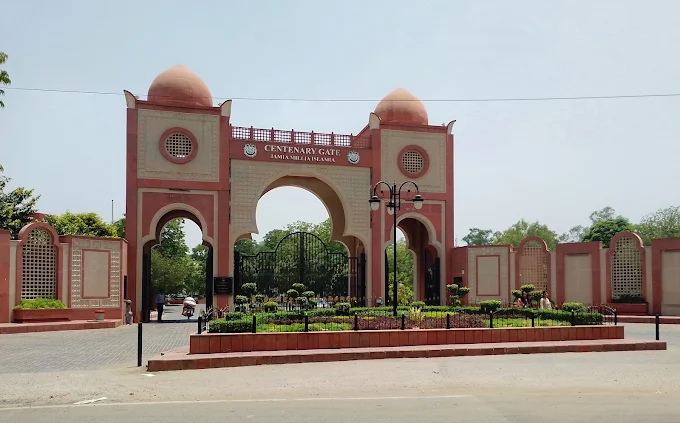
But in practice, it has always functioned as a general, secular central university, and it remains one of India’s most respected. That founding story built by freedom fighters, meant as a training ground for people who could stand on their own feet with dignity, is exactly why what’s happened to its internal associations over the past few years has stung so many people connected to the place. There are three bodies worth looking at together, because each tells the same story from a different angle: the Jamia Teachers Association, the Jamia Administrative Staff Association, and the Students’ Union.
The Teachers’ Association
The JTA was formed in 1967 and had run itself for decades with a self-governed constitution, its own elected executive committee, the works. Its committee, elected in 2020, was due to hand over in 2022, and when it tried to hold fresh elections, the university stepped in. The administration appointed its own returning officer’s authority into question, nullified the pending election, dissolved the association outright, sealed its office, and barred its office bearers from touching its premises or funds. The JTA took this to the Delhi High Court, arguing that this violated its members’ constitutional right to freely form and self-govern an association. The university’s defense lawyer argued in the court that the Jamia Millia Islamia Act, 1988, provides it with legitimate power to control or dissolve staff bodies. In October 2025, Justice Sachin Datta ruled for the Jamia Teachers Association, finding the university’s actions appeared to be administrative in nature, bearing no rational connection a valid regulatory purpose, and that such powers must be exercised in accordance with constitutional values and natural justice, not as tools to supersede fundamental rights. The dissolution order was quashed by the Delhi High Court.
The Administrative Staff Association.
JASA has existed for years as the collective voice of Jamia’s non-teaching staff. It’s shown up in public records making its own statements on university matters, so it’s a real, functioning body, not a paper entity. Exactly how JASA has fared through this same period of tightened control is harder to pin down from public reporting than the JTA’s case, which has a full court record behind it. What is clear is the direction of travel: an administration willing to dissolve one long-standing association is operating in an environment where staff bodies generally have less room to push back than they once did.
The Students’ Union.
This is the oldest wound of the three. Jamia’s Students’ Union last held elections in 2006. The administration halted the process, citing concerns over campus disturbances, after the union’s president was allegedly beaten up, and never restarted it. Students marked eleven years without a union with a hunger strike in 2017; the administration agreed “in principle” to bring it back, and then did not restore the union structure despite that promise. It’s now been close to two decades. Jamia isn’t the only campus in this position. Banaras Hindu University and Aligarh Muslim University have their own stalled elections, but the elections are not held in these universities too, but Jamia’s gap is among the longest of any major Indian university.
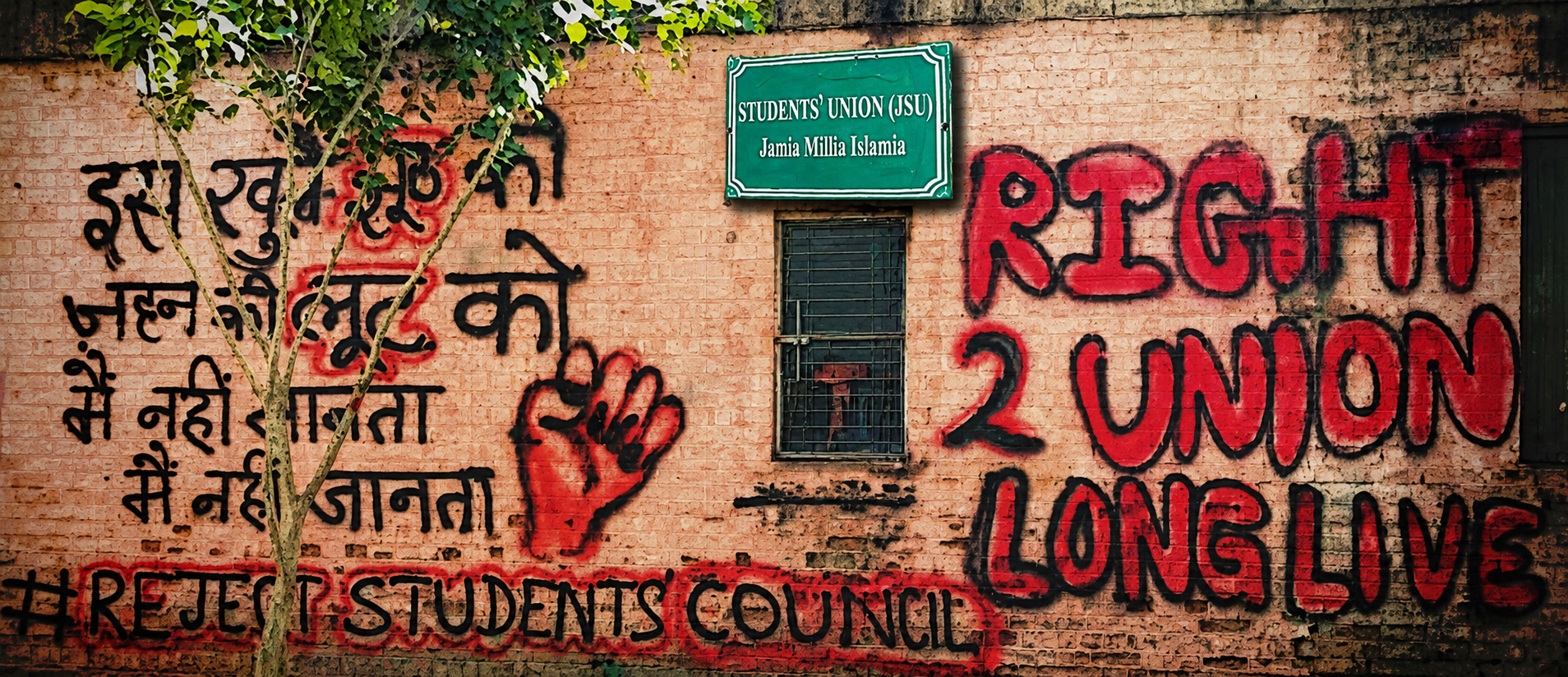
This matters legally, not just symbolically. In 2006, the Supreme Court set up the Lyngdoh Committee, headed by former Chief Election Commissioner J.M. Lyngdoh, specifically to fix student politics rather than kill it, curbing money and violence in campus elections while making sure elections still happened. The committee’s report, which the Supreme Court accepted, is direct on this point: institutions of higher education, both private and public, should conduct student union elections every year, with a nominated union allowed only as a short-term, interim measure where conditions are genuinely unsafe, not as a permanent substitute. Nineteen years on, Jamia is still treating what was meant to be an exception as the default.
The three together formed a pattern that is difficult to miss. In October 2024, a new vice chancellor, Prof Mazhar Asif, took charge; shortly after that, the administration made drastic changes. It started issuing an order banning protests, dharnas, and sloganeering anywhere on campus without prior permission from the administration. This rule covers teachers, staff, and students alike, not any one group. Going back even further, it is evident that the university responded explicitly in its handling of the 2019 protests against the CAA/NRC, during which Delhi police had forcibly entered the university and used extreme brute force on the students, an FIR was registered, and a faculty member was suspended in connection with the campus protest. RTI data clearly stated that there has been an increase in the number of disciplinary actions against students, from 17 cases in the year 2019 to more than a hundred in 2023. which indicates the intention of the administration to do this as part of a wider ideological push often called “saffronisation” to bring minority central universities into closer alignment with Hindu-nationalist politics.
Why does any of this actually matter, beyond the specific grievances of specific people? Because an association isn’t paperwork. It’s the mechanism that lets a group of people negotiate with power together instead of each person facing an administration alone. A university is also, whether anyone likes it or not, a training ground for how young and working people learn to organize, argue a position, lose a vote, win one, and build the muscle for public life afterward. Strip out the teachers’ body, leave the staff association weakened, and leave students with no elected union for twenty years running, and what’s left inside the institution is a collection of individuals easier to warn, easier to suspend, easier to simply wait out, one by one.
The administration’s side deserves a fair hearing too: it says it has a statutory duty to regulate these bodies, not simply let them run themselves indefinitely, and that unregulated student politics can tip into disruption or worse. But it’s worth sitting with the fact that when the JTA’s case reached a court with no stake in the outcome, the court sided with the association, not the university, finding the dissolution had no legitimate regulatory basis at all. That’s not proof of motive in every instance, but it is a real data point, from an independent institution, about where the line between “regulation” and overreach actually sat in at least this one case.
The way forward
The Jamia administration should reinstate all three bodies to ensure better governance and facilitate spaces for academic discussion. This will help build a stronger academic community, promote research and intellectual exchange, and provide a proper institutional channel to address the concerns of students and non-teaching staff.

Mohammad Hesham Atik is an undergraduate student of Psychology at Jamia Millia Islamia, with a minor in Economics. He has also pursued certified courses in Urdu from Jawaharlal Nehru University. His interests include psychology, social issues, and cultural studies.